
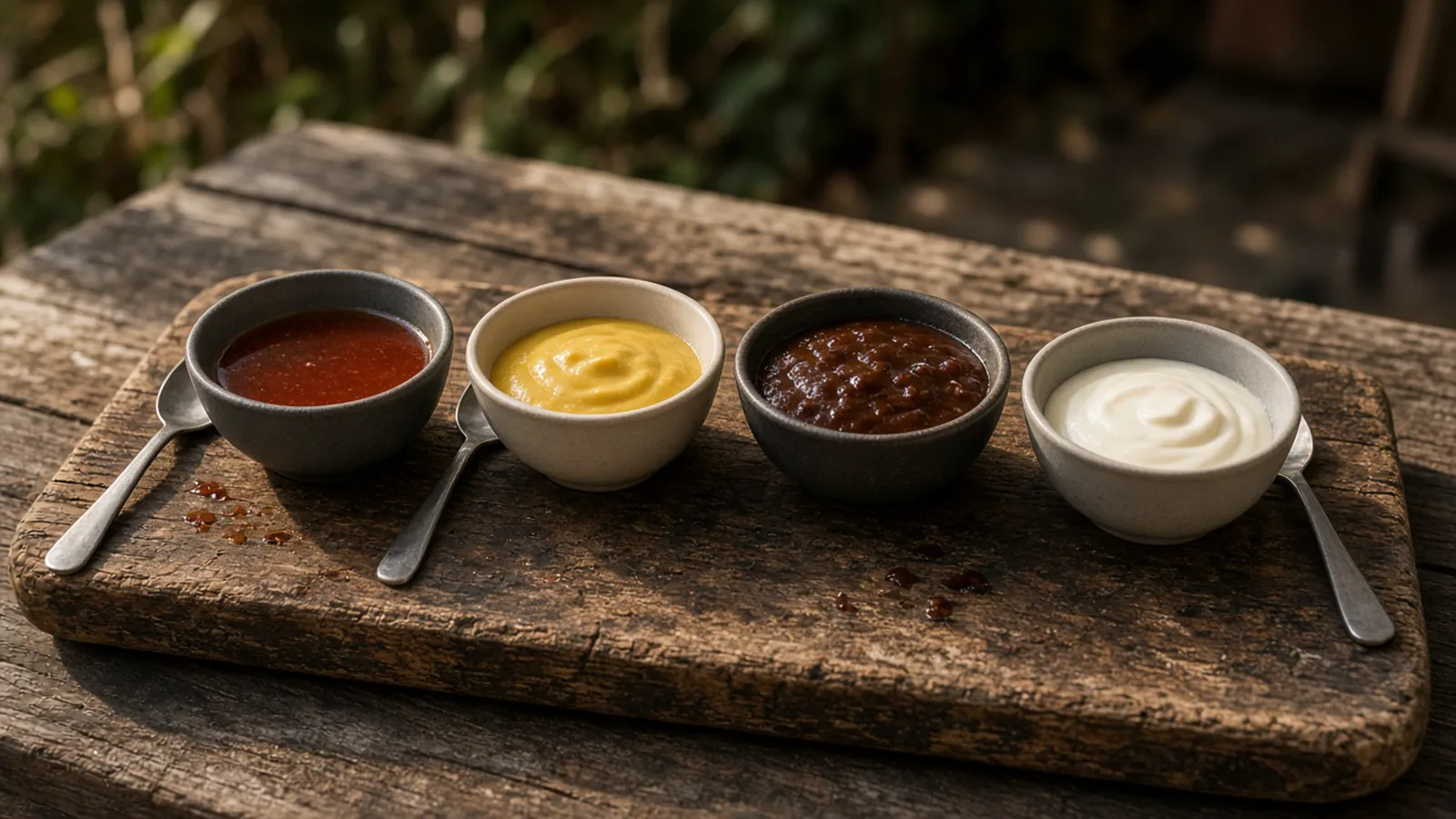
A barbecue sauce is the finish for a specific meat, and the regions did not land on the same pot. Eastern Carolina is vinegar and pepper, Lexington adds a little tomato, South Carolina is mustard, Kansas City is thick and sweet, Texas stays thin, Memphis can be dry or a tangier tomato sauce, and Alabama white is mayonnaise for chicken.
The salt spoons below are the ones Meathead prints, and those are Morton coarse kosher. Table salt is about twice as salty by volume, so use half as much table salt in the same cup. Diamond Crystal is lighter than Morton, so the same tablespoon under-salts. Taste the pot. The vinegar or the mustard should still be the loudest thing in it.
Season the meat before any of this. A pork shoulder wants the pork butt rub, then the hours on how to smoke pork butt. The map of the other rubs is the BBQ rub recipes index.
Eastern Carolina vinegar
Eastern Carolina sauce is a thin, sharp mop for whole hog and for pulled pork. Meathead's East Carolina vinegar sauce is distilled vinegar, a little sugar, Morton coarse salt, red pepper flakes, black pepper, and a teaspoon of hot sauce. There is no ketchup in it. He shakes it in a jar and lets it sit at least 12 hours. You do not simmer it.
The simple base is 1 1/2 cups distilled vinegar to 2 tablespoons sugar, plus 1 tablespoon Morton coarse salt, 2 teaspoons red pepper flakes, 2 teaspoons black pepper, and 1 teaspoon hot sauce. That is a vinegar sauce with enough sugar to round the edge, and with the heat in the pepper, not in a tomato paste.
It suits chopped whole hog and pulled pork shoulder, tossed while the meat is hot so the vinegar can move through the pile. It also works as a mop during the cook. Pour a few ounces into a cup and paint from the cup. The brush picks up raw meat juices, and those juices do not go back into the jar you will put on the table.
Pros
- Vinegar cuts the fat in a chopped whole hog or a pulled shoulder, and the sauce stays thin enough to toss through the pile.
- The jar is five minutes of stirring, and it keeps in the fridge because it is mostly vinegar.
Cons
- There is no tomato body. A table that wants a sweet red glaze will taste pepper and acid and ask where the sauce is.
- The same sharpness on a lean chicken breast is a lot of vinegar and not much fat for it to cut.
Lexington dip
About ninety miles west, the Piedmont sauce is still mostly vinegar, and it picks up a little ketchup. People there call it dip, and they put it on pork shoulder. Meathead's Lexington dip is 1 cup distilled vinegar, 1/4 cup ketchup, 1/4 cup apple juice, 1 teaspoon hot sauce, 3 tablespoons light brown sugar, 1/2 tablespoon Morton coarse salt, 1 teaspoon red pepper flakes, and 1 teaspoon black pepper. Whisk it and rest it at least 3 hours. Overnight is better. He has seen both distilled and cider vinegar in North Carolina, and he prefers distilled in this pot.
The simple base is 4 parts vinegar to 1 part ketchup. One cup to a quarter cup is that ratio. The apple juice and the brown sugar round it. It is still thin. It is not a Kansas City glaze.
It suits a smoked pork shoulder, mopped from a cup during the cook and served from a cruet at the table. Ribs can take a light coat at the end. A thick painting early will not turn this into a sticky glaze, and it will keep the bark wet.
Pros
- You still get the vinegar that belongs on pulled pork, with enough ketchup and sugar that the pot tastes finished.
- It stays thin, so it penetrates chopped pork instead of sitting on top in a sweet layer.
Cons
- A quarter cup of ketchup is the whole tomato note. Anyone measuring by a Kansas City bottle will undershoot the body they wanted.
- The pepper is still there. A mild crowd tastes heat before they taste tomato.
South Carolina mustard
In a band of the South Carolina midlands, from around Columbia toward the coast, the sauce is yellow because the base is yellow mustard. Meathead's Carolina gold is 2 cups prepared yellow mustard, 2/3 cup cider vinegar, 3 tablespoons tomato paste, 3/4 cup sugar, and a short list of spices, simmered about 10 minutes. The mustard is the body. The tomato paste is a tint, not a second sauce.
The simple base is about 3 parts yellow mustard to 1 part cider vinegar. Two cups to two-thirds of a cup is that ratio, with 3/4 cup sugar so the tang has somewhere to land. Because of that sugar, treat it like a glaze on anything sitting over a hot grate: last 10 to 15 minutes, then a bowl for the table.
It suits pulled pork, smoked sausage, and pork chops. Chicken thighs can take it. A packer brisket has no tradition of wearing this pot, and the mustard will taste like the loudest thing on the plate.
Pros
- Mustard brings the same cut-the-fat job vinegar does, with more body, so the pork tastes tangy and still looks sauced.
- One simmer of about 10 minutes pastes the jar, and leftovers keep in the fridge.
Cons
- Three-quarters of a cup of sugar will darken on a hot grate if the sauce rides the whole cook.
- The mustard is the point. A table that wanted ketchup will taste the yellow base in every bite.
Kansas City
Kansas City sauce is the thick, sweet, tomato-and-molasses pot most grocery bottles are copying. Meathead's classic Kansas City sauce builds it from 2 cups ketchup, 1 cup dark brown sugar, 1/4 cup dark molasses, 1/2 cup cider vinegar, 1/4 to 3/4 cup honey, plus mustard, Worcestershire, and a cooked onion. He simmers it about 15 minutes and likes it better the next day. It is a lot of sugar on purpose. The vinegar and the heat are there so the sweet has something to push against.
The simple base is 2 cups ketchup to 1 cup brown sugar to 1/4 cup molasses. That is the thick, dark pot. Honey, on his range, is how you push it sweeter still. Use the low end of the honey the first time.
It suits ribs, burnt ends, and chicken you want glazed. Paint it in the last 15 minutes. The sugar, on top of the sugar already in a rib rub, burns when it rides the whole cook. The timing on a rack is how to smoke ribs. A pork butt can take a little in the pile after it is pulled. A whole shoulder painted for hours will go dark and bitter at the edges.
Pros
- Ketchup, brown sugar, and molasses give you the thick glaze people mean when they ask for barbecue sauce on ribs.
- The same pot works as a last-minute glaze on chicken and as a spoon through burnt ends.
Cons
- That much sugar blackens if it sees a hot grate for more than a few minutes. Stand there for the last coat.
- On a long beef cook, the sweetness covers the bark a Central Texas slice is supposed to show.
Texas
Central Texas puts the brisket first. Meathead's Texas-style brisket quotes Daniel Vaughn on serving it with nothing on the slice, and Meathead himself skips mopping a packer because a mop softens the bark, cools the meat, and slows the cook. When he does serve a sauce, he wants a thin, tart, tomato-and-stock liquid, a few spoons on the side, and he is explicit that it is not the thick sweet Kansas City pot.
His Texas barbecue juice is that liquid: 2 cups beef stock, 1 cup lager, 1/4 cup ketchup, 1/4 cup cider vinegar, 2 tablespoons brown sugar, Worcestershire, steak sauce, chili, and cumin, simmered about 15 minutes. He wrote it for pits that cook a couple of feet over coals and open often, where a mop puts moisture back. On a closed kamado, leave the bark alone and serve the cup at the table. Mix in a spoon of brisket drippings if you want it to taste like the meat.
The simple base is 2 cups beef stock to 1 cup beer to 1/4 cup ketchup. It should pour like a thin gravy. If it mounds on a spoon the way Kansas City sauce does, it has boiled too far or the ketchup got heavy.
It suits brisket, beef ribs, and sausage. He also uses it on pork. The place it earns its keep is beef, next to a slice that can stand without it. The cook for that slice is how to smoke a brisket, with the brisket rub and no sugar in the rub.
Pros
- Stock and beer keep the sauce thin, so a slice of brisket still tastes like beef after a spoon of it.
- Two tablespoons of brown sugar is the sweetness. The pot stays tart instead of candy-sweet.
Cons
- Mopping a closed-cooker brisket with it softens the bark you spent all day drying.
- A rib table that wanted a sticky glaze will taste broth and chili and reach for the Kansas City pot.
Memphis
Memphis has two plates, and they are both the style. Robert F. Moss, on Amazing Ribs, describes the city's sauce as dark, tangy, and sweet, from tomato and molasses, on pork shoulder sandwiches and on wet ribs. The same history is where dry ribs come from: Charlie Vergos's Rendezvous basted with water and vinegar, then a spice rub, over a hot charcoal fire, with no sweet glaze. Pork shoulder and pork ribs are the meats. Charcoal is the fuel he names.
A home pot in the wet direction, built from that tomato-and-molasses description and kept thinner than the Kansas City batch above, is 1 cup ketchup, 2 tablespoons molasses, and 1/4 cup cider vinegar, simmered about 15 minutes with salt, black pepper, and a pinch of cayenne. That small pot follows the tomato, molasses, and tang he describes. It is not a copy of a restaurant recipe. The dry plate needs no sauce pot at all. Season with a rib rub, and if you baste, use water and vinegar the way that history describes the Rendezvous ribs.
Wet Memphis suits a pork sandwich and ribs you want tangy rather than candy-sweet. The dry plate suits a rack where the bark is the point. Both want the sauce, if any, late. The rib cook is how to smoke ribs. A chopped shoulder for the sandwich follows how to smoke pork butt.
Pros
- The dry plate keeps the bark, because the baste is water and vinegar and the sweetness never gets a chance to burn.
- The wet pot is tangier and thinner than Kansas City, so chopped pork still tastes like pork under the tomato.
Cons
- Painting the wet sauce on early gives the molasses the whole cook to darken.
- A dry rack has no sweet glaze. Set a bowl out if half the table wants one.
Alabama white
Alabama white sauce is mayonnaise loosened with vinegar, and it belongs on chicken. Meathead's white sauce, inspired by Big Bob Gibson's in Decatur, is 3/4 cup mayonnaise, 1/3 cup cider vinegar, 1/4 cup lemon juice, 1/4 cup apple juice, a tablespoon of horseradish, a tablespoon of coarse black pepper, garlic, a teaspoon of mustard powder, and a little cayenne and Morton salt. Whisk it and chill it at least two hours. Do not boil it. Mayonnaise breaks and the pot turns greasy.
The simple base is a bit more than 2 parts mayonnaise to 1 part cider vinegar. Three-quarters of a cup to a third of a cup is that ratio. Lemon and horseradish are the brightness. Black pepper is the speck you should see.
It suits smoked or grilled chicken and turkey, painted on after the meat is cooked, or served cold beside it. Meathead cooks the chicken to temperature and then paints. On this site that finish is 165°F in the breast, on how to smoke chicken. He is plain that the sauce is a poor match for pork or beef. If the bowl is unpopular on the bird, it still works as a dressing on slaw.
Pros
- Mayo and vinegar coat lean smoked chicken where a tomato glaze would only add sugar.
- The pot is cold, so you whisk it while the bird cooks and it is ready when the breast hits 165°F.
Cons
- Heat breaks the mayonnaise. A long baste over a hot grate turns it oily.
- On pulled pork or brisket it tastes like a dressing that missed the slaw.
A short note on other sauces
St. Louis plates often eat like Kansas City: sweet, tomato, thick, on ribs. If that is the pot you want, make the Kansas City batch and stop there. Hawaiian sauce leans on pineapple and soy, which is a sweeter, saltier glaze than any of the regional pots above, and it still belongs in the last minutes because of the sugar. A gochujang glaze is a fermented-chile paste from a different pantry. It can paint chicken or ribs at the end, and it is not a stand-in for vinegar sauce on a whole hog.
Those three are finishes you can borrow. They are not a reason to stir every regional pot into one jar. The rub on the meat is still the one matched to the cook, from the rubs index, and the sauce is the last choice, in a bowl if you are not sure the table agrees.