
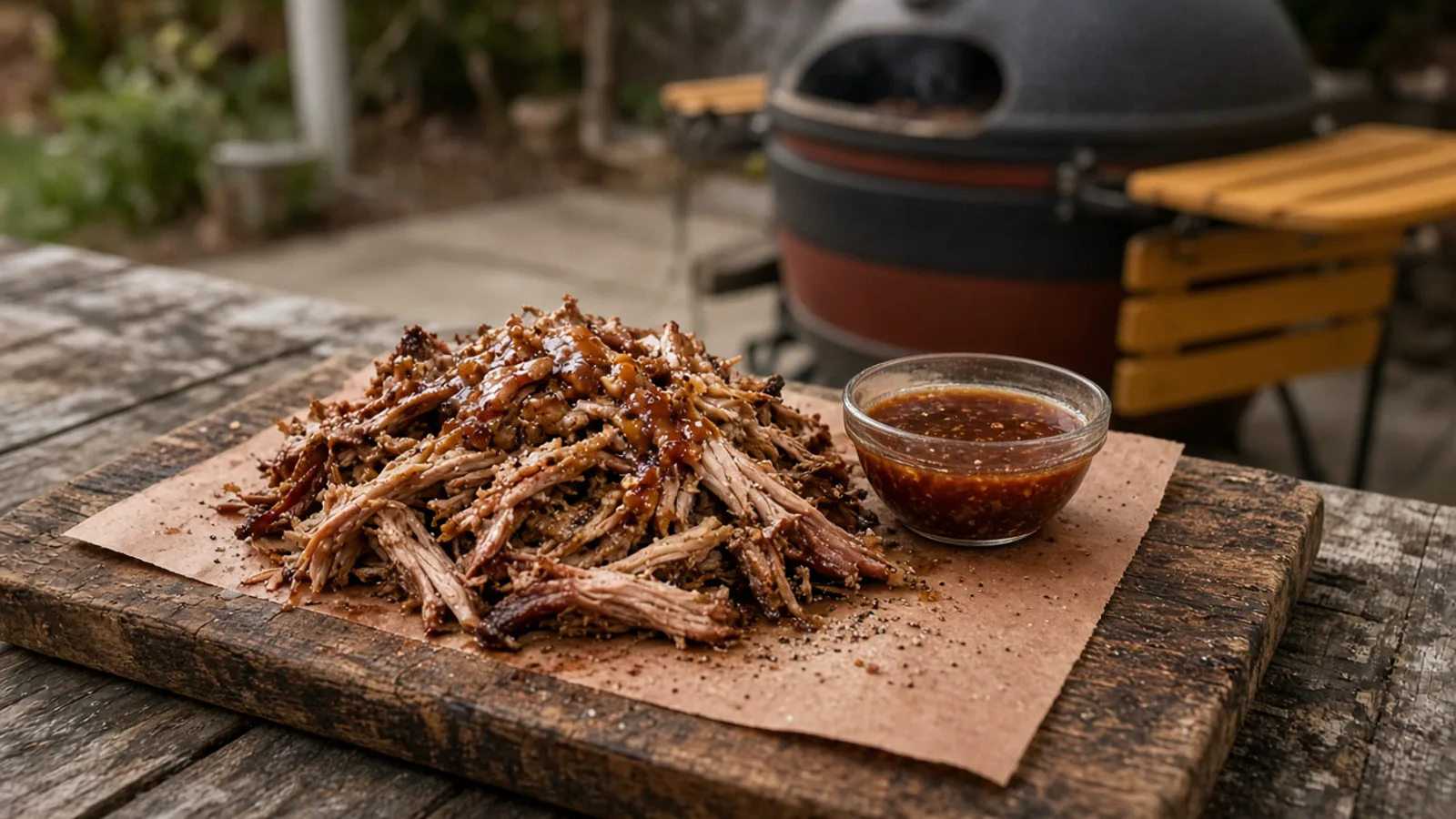
Carolina BBQ sauce is a thin pork sauce, and the Carolinas did not settle on one jar. Eastern North Carolina is vinegar and pepper, Lexington dip adds a little ketchup, and South Carolina mustard sauce, Carolina Gold, is yellow mustard simmered with cider vinegar and sugar.
Recipe
Eastern North Carolina vinegar-pepper sauce
About 1 2/3 cups, enough to mop and finish one pork shoulder. Prep 5 minutes, plus at least 12 hours to rest.
Ingredients
| Ingredient | Volume | Weight |
|---|---|---|
| Distilled white vinegar | 1 1/2 cups | about 360 g |
| Sugar | 2 tablespoons | about 25 g |
| Morton coarse kosher salt | 1 tablespoon | about 14 g |
| Crushed red pepper flakes | 2 teaspoons | about 4 g |
| Finely ground black pepper | 2 teaspoons | about 5 g |
| Hot sauce | 1 teaspoon | about 5 g |
Steps
- Pour the vinegar, sugar, Morton salt, red pepper flakes, black pepper, and hot sauce into a jar with a lid.
- Shake until the sugar and salt dissolve and the flakes are scattered through the vinegar.
- Rest the jar at least 12 hours. Overnight is the habit. Leave this pot off the stove.
- To mop, pour a few ounces into a cup and paint from the cup. Discard that cup. Serve from the jar that the brush never touched.
This is Meathead's published East Carolina vinegar sauce, with kitchen weights so the spoon matches the other cards on this site. He prefers distilled vinegar. White, light brown, or dark brown sugar all work in his pot. A level tablespoon of brown sugar is about 12 g on the pork butt rub, so two tablespoons of brown sugar are about 24 g. Table salt is half the Morton measure. There is no ketchup in this jar.
The weights are kitchen weights for the volumes Meathead prints: about 240 grams to a cup of vinegar, about 14 grams to a tablespoon of Morton from the same salt math as the rubs, and about 12.5 grams to a tablespoon of granulated sugar. Taste the jar. A scale gets you close. Your vinegar and your pepper still get the last word.
Season the shoulder before any of this. The coat is the pork butt rub. The hours on the pit are how to smoke pork butt. The pull is internal temp for pulled pork, around 203°F and a bone that wiggles. The map of the other regions, Kansas City through Alabama white, stays on BBQ sauce styles. The rubs that go under a sauce are the BBQ rub recipes.
What makes it Carolina
A Carolina sauce cuts the fat in chopped pork. It stays thin enough to run through a pile of shreds, and the loud flavor is acid or mustard, with the sugar there to round the edge. Eastern has no tomato at all. Lexington uses a quarter cup of ketchup in a cup of vinegar, which is a tint and a little body, and the pot still pours. South Carolina builds the body from yellow mustard, then simmers it, and that is the one Carolina pot with enough sugar to treat like a glaze.
The other styles solve a different plate. Kansas City is the thick, sweet, tomato-and-molasses glaze most grocery bottles copy, and it goes on ribs in the last minutes. Central Texas puts the brisket first and, when there is a sauce, keeps it thin and beefy. Memphis can be a dry rack or a tangier tomato sauce. Alabama white is mayonnaise and vinegar for chicken, whisked cold. Those pots, with their own ratios, live on BBQ sauce styles. This page is the three Carolina jars.
| Eastern vinegar | Lexington dip | South Carolina mustard | |
|---|---|---|---|
| The loud flavor | Distilled vinegar and pepper | Vinegar, with a little ketchup | Yellow mustard |
| Tomato | None | 1/4 cup ketchup in 1 cup vinegar | 3 tablespoons tomato paste, as a tint |
| Heat | Shake, then rest 12 hours | Whisk, then rest 3 hours or overnight | Simmer about 10 minutes |
| On the pork | Mop from a cup, then toss the pull | Mop from a cup, then a cruet at the table | Last 10 to 15 minutes, then the table |
| Yield here | About 1 2/3 cups | About 2 cups | About 3 cups |
Eastern Carolina vinegar
The card is the whole Eastern pot: 1 1/2 cups distilled vinegar, 2 tablespoons sugar, 1 tablespoon Morton coarse salt, 2 teaspoons red pepper flakes, 2 teaspoons fine black pepper, and 1 teaspoon hot sauce. Meathead shakes it and lets it sit at least 12 hours so the pepper blooms in the acid. Simmering it drives off the vinegar you made the sauce to taste.
He has tried cider vinegar in this jar and prefers distilled, because the vinegar taste stays clean. Cider vinegar is the right call in the mustard sauce below. In this one it pulls the jar toward apples. Use it if that is the flavor you want, and keep the rest of the card.
The sugar is 2 tablespoons, about 25 grams if it is granulated. He says white, light brown, or dark brown all work. Brown sugar brings a little molasses. Two level tablespoons of brown sugar are about 24 grams if you use the tablespoon from the pork butt rub. That spoon of sugar rounds the vinegar. It does not turn the jar into a glaze.
The salt is Morton, about 14 grams for the tablespoon, from the same Morton math as the rubs: a third of a cup of Morton is about 73 grams, and a tablespoon is a bit under a fifth of that. Table salt in that same tablespoon is too much. Use half a tablespoon of table salt. Diamond Crystal in the Morton spoon is lighter, so the jar tastes shy of salt until you add a pinch and taste again.
The heat is the flakes, the black pepper, and one teaspoon of hot sauce. The flakes bloom during the rest. A jar you taste at minute five is milder than the jar you open the next day. There is no ketchup, no tomato paste, and no mustard in this pot. If the table wants a red sauce, that is Lexington or a Kansas City glaze, not a heavier pour of this one.
Pros
- Vinegar cuts the fat in chopped whole hog or pulled shoulder, and the sauce is thin enough to toss through the pile.
- The jar is a shake and a rest, and a clean jar in the fridge keeps because it is mostly vinegar.
Cons
- There is no tomato body. A table that wants a sweet red glaze tastes pepper and acid and looks for the other pot.
- The same sharpness on a lean chicken breast is a lot of vinegar and not much fat for it to cut.
Lexington dip
About ninety miles west, the Piedmont still starts with vinegar and adds a little ketchup. People there call it dip, and they put it on pork shoulder. Meathead's Lexington dip is the jar below. He whisks it and rests it at least 3 hours. Overnight is better, and he says a week in the fridge is best before you use it. He has seen both distilled and cider vinegar in North Carolina, and he prefers distilled in this pot. The apple juice is his step away from the plainest dip. He borrowed it from a sauce he likes in Nashville, North Carolina, and it rounds the vinegar without a cup of sugar.
This is still 4 parts vinegar to 1 part ketchup. One cup to a quarter cup is that ratio. The pot should pour. If it mounds on a spoon the way a Kansas City sauce does, the ketchup got heavy or the pot cooked down, and this dip is not cooked down. You whisk it. You do not simmer it.
Lexington dip recipe
About 2 cups, which Meathead prints as the yield. About 10 minutes to whisk, then at least 3 hours in the fridge, and overnight is better.
| Ingredient | Volume | Weight |
|---|---|---|
| Distilled white vinegar | 1 cup | about 240 g |
| Ketchup | 1/4 cup | about 68 g |
| Apple juice | 1/4 cup | about 60 g |
| Light brown sugar | 3 tablespoons | about 36 g |
| Hot sauce | 1 teaspoon | about 5 g |
| Morton coarse kosher salt | 1/2 tablespoon | about 7 g |
| Crushed red pepper flakes | 1 teaspoon | about 2 g |
| Finely ground black pepper | 1 teaspoon | about 3 g |
- Whisk the vinegar, ketchup, apple juice, brown sugar, hot sauce, Morton salt, red pepper, and black pepper in a bowl until the sugar dissolves.
- Pour it into a lidded jar and rest it in the fridge at least 3 hours. Overnight is better.
- Split the jar. Mop from one portion, from a cup, during the cook. Serve the other portion from a cruet, and keep the brush out of it.
- Table salt is half the Morton measure. Diamond Crystal in that half-tablespoon is lighter, so taste before you add more.
The brown sugar is 3 tablespoons, about 36 grams at the 12 gram tablespoon this site uses. That is more sugar than the Eastern jar and still a small dose next to the 3/4 cup in the mustard sauce. The ketchup is about 68 grams, a quarter cup. It colors the vinegar and softens the edge. It is the whole tomato note.
Pros
- You still get the vinegar that belongs on pulled pork, with enough ketchup and sugar that the pot tastes finished.
- It stays thin, so it runs through chopped pork instead of sitting on top in a sweet layer.
Cons
- A quarter cup of ketchup is the whole tomato note. A cook measuring toward a Kansas City bottle will undershoot the body they wanted.
- The pepper is still there. A mild crowd tastes heat before they taste tomato.
South Carolina mustard
In a band of the South Carolina midlands, from around Columbia toward the coast, the sauce is yellow because the base is yellow mustard. German settlers in that belt put mustard with pork, and the barbecue sauce followed. Meathead's Carolina gold is the simmered pot below. He prints about 3 cups, and he simmers it about 10 minutes so the jar is pasteurized, then cools it and keeps the leftovers in the fridge for months.
The simple base is about 3 parts yellow mustard to 1 part cider vinegar. Two cups of mustard to 2/3 cup of vinegar is that ratio. The 3/4 cup of sugar is why this one can darken on a hot grate. The tomato paste is 3 tablespoons, a tint, and he says ketchup can stand in for the paste. The mustard is ballpark yellow mustard. Dijon takes the jar somewhere else.
South Carolina mustard sauce
About 3 cups. Mix the pot, then simmer about 10 minutes.
| Ingredient | Volume | Weight |
|---|---|---|
| Prepared yellow mustard | 2 cups | about 500 g |
| Cider vinegar | 2/3 cup | about 160 g |
| Sugar | 3/4 cup | about 150 g |
| Tomato paste | 3 tablespoons | about 48 g |
| Mustard powder | 1 tablespoon | about 6 g |
| Morton coarse kosher salt | 2 teaspoons | about 9 g |
| Onion powder | 2 teaspoons | about 5 g |
| Garlic powder | 2 teaspoons | about 6 g |
| Chicken bouillon granules | 2 teaspoons | about 10 g |
| Dried rosemary, crushed | 2 teaspoons | about 2 g |
| Celery seed | 1 teaspoon | about 2 g |
| Finely ground black pepper | 1 teaspoon | about 3 g |
| Chipotle hot sauce, or the hot sauce you have | 1/2 teaspoon | about 3 g |
- Stir everything in a small saucepan. Crush a bouillon cube first if you are using cubes. Meathead counts 1 cube as 1 teaspoon, so 2 teaspoons of granules is 2 cubes. He wants a chicken concentrate. Plain chicken stock in place of the granules waters the pot down.
- Bring it to a simmer over medium-high heat, then simmer about 10 minutes over medium heat. Stir so the sugar dissolves and the mustard does not sit and scorch.
- Cool it, pour it into a clean jar, and keep the jar in the fridge.
- On a grate, paint it in the last 10 to 15 minutes. Put a bowl of the rest on the table. Table salt is half the Morton measure.
The rosemary, celery seed, onion, and garlic are the "short list of spices" in his pot. Crush the rosemary so you are not serving needles. Celery seed is the seed, not celery salt, which would stack salt on the Morton you already measured. Onion powder and garlic powder melt into the simmer. Granulated onion or garlic in the same spoon is a coarser measure, so use them by taste if that is the jar you own.
Pros
- Mustard does the same cut-the-fat job vinegar does, with more body, so the pork tastes tangy and still looks sauced.
- One simmer of about 10 minutes pastes the jar, and a clean leftover jar keeps in the fridge.
Cons
- Three-quarters of a cup of sugar will darken on a hot grate if the sauce rides the whole cook.
- The mustard is the point. A table that wanted ketchup will taste the yellow base in every bite.
On pulled pork
These sauces were built for hog and for pork shoulder. The cook under them is how to smoke pork butt, rubbed with the pork butt rub. For a shoulder you are going to sauce with straight Eastern vinegar, the Carolina turn on that rub skips the brown sugar and keeps the salt and coarse pepper. The vinegar belongs in the jar, not in the rub bowl. A picnic can wear the same coat. The clock for that lower piece is only a start, because the skin and the hock change the shape.
Pull when the meat is ready, not when the sauce is. That finish is internal temp for pulled pork: around 203°F in thick meat, off the bone, and a blade that wiggles free. The thermometer notes for the probe that tells you that are on meat thermometers. Rest the shoulder, then pull it hot, and sauce the hot meat. Vinegar moves through a warm pile. It sits on a cold one.
Mop
A mop is sauce brushed on during the cook. Eastern and Lexington are thin enough to do that job. Pour a few ounces into a cup before you start, and paint from the cup every so often while the bark still has time to dry between coats. Meathead's Eastern method is about once an hour. A heavy soak every time you open the lid puts water back on the surface and stretches the stall.
The brush picks up juices from the meat. Those juices do not go back into the jar you will put on the table, and they do not go back into the cup for the next hour if you can help it. Discard the mop cup when you are done painting. The mustard sauce is a poor all-day mop. The sugar in that 3/4 cup wants the last minutes, which is the same timing BBQ sauce styles gives any sweet pot.
Finishing splash
Once the pork is pulled and still steaming, splash clean sauce from the jar and toss. Start with a few tablespoons through a pound or so of meat and taste a shred. Eastern should taste like pork and vinegar, with pepper in the background. Lexington should taste like that plus a little tomato. Mustard sauce should taste like mustard and pork, not like a puddle of sugar.
Toss in a bowl, not on the board you just pulled on, so the bark you want to mix back through the pile stays with the meat. Add sauce in rounds. You can always splash more. A pile swimming in vinegar tastes like the jar won.
Table sauce
Whatever you did not toss goes in a cruet or a small bowl, from the jar the brush never touched. People who want more heat or more tang can add it on the sandwich. People who want the bark can leave it in the bowl. Set the Eastern jar out even if you tossed some, because the pepper that bloomed overnight is the point of making it the day before. A mustard bowl next to an Eastern cruet lets the table pick. Stirring the two jars together makes a third sauce you did not write down.
Heat and sweetness
The Eastern card is the middle of that vinegar pot. The pepper is 2 teaspoons of flakes plus 2 teaspoons of black pepper plus 1 teaspoon of hot sauce. That reads warm after the rest, and it is still a sauce you can put on a sandwich for a mixed table.
For a milder jar, drop the flakes to 1 teaspoon and keep the black pepper. For a hotter jar, add 1 teaspoon of flakes or 1 teaspoon of hot sauce, then wait through the rest before you decide it needs another. The flakes get louder overnight. Chasing heat at minute five is how the next-day jar bites.
If the vinegar is too sharp, add sugar 1 teaspoon at a time and shake again. Meathead's note on a jar with too much vinegar is more sugar, or a little bacon fat or melted butter to blunt the acid, or a new batch. Fat softens the edge without making the pot sweet. A tablespoon of sugar, dumped in because the first taste was bright, walks this jar toward the mustard sauce's job.
Lexington is already the rounder vinegar pot. Three tablespoons of brown sugar and a quarter cup of apple juice are doing that work. If it tastes thin and sharp, give it the overnight rest before you add ketchup. More ketchup is how dip becomes a tomato sauce. If it tastes flat, the vinegar is the thing to add, a tablespoon at a time.
The mustard sauce is the sweet Carolina pot on purpose. Three-quarters of a cup of sugar in about 3 cups of sauce is the dose he published. Cutting that sugar to 1/2 cup makes a sharper mustard sauce, and the simmer is the same 10 minutes. Adding molasses or a cup more sugar makes a different glaze. If the mustard is too loud, you wanted Lexington. Thinning Carolina Gold with ketchup hides the reason you made it.
Storage
Use a jar with a lid that actually seals. Leave the Eastern and Lexington jars in the fridge for the rest they need, and keep them there afterward. Meathead's Eastern page says to refrigerate what you do not use and that it should keep for months, and the questions on that same page say a sealed fridge jar keeps several weeks up to a couple of months. His mustard method says leftovers keep in the fridge for months. I am quoting those lines. I am not giving you a lab date from this kitchen.
The mop cup is the jar that does not keep. Raw meat juices on the brush make that cup a same-day thing. Pour it out. Wash the brush. The serving jar stays clean because you split it before you painted.
A jar that smells like anything other than vinegar, mustard, and pepper, or that shows mold, gets thrown out. Vinegar is acidic, and that is why these pots last in the fridge. It is not a reason to leave a dipped brush in the jar on the counter through a long lunch. These are fridge sauces. They are not a canned good you store in the cupboard, and this page is not a canning recipe.
Shake the Eastern jar before you pour. The flakes settle. The mustard sauce can thicken in the cold. Stir it. If it simmered so long that it turned pasty, thin a serving spoon with a splash of cider vinegar rather than a splash of water, so the tang stays put. Label the lid with the style and the month. Three Carolina jars in one door look alike until you taste the wrong one on the chicken.
When the jar goes wrong
The Eastern sauce tastes like plain vinegar. The sugar and the rest are what round it. Two tablespoons is the whole sweetness. Give the flakes their 12 hours before you judge the heat, then add a teaspoon of sugar if the acid is still the only thing you can taste.
The dip tastes like ketchup. The ratio drifted. A quarter cup of ketchup in a cup of vinegar is the whole tomato. If you poured by the grocery-bottle habit, add vinegar until it pours and tastes like vinegar first. Then rest it again.
The mustard sauce scorched. The simmer was too hot or you stopped stirring. Ten minutes at a gentle simmer pasteurizes the pot. A hard boil reduces it and sticks mustard sugars to the pan. If the bottom is bitter, stop and start the saucepan again. Scraping the brown bits back in saves the pan and ruins the jar.
The sauce never came together. Eastern and Lexington are meant to be shaken, not emulsified. Flecks of pepper on the bottom are the sauce working. A mustard sauce that looks broken after the fridge just needs a stir. If the bouillon stayed in grains, crush the next cube finer and give the simmer its full 10 minutes.
You mopped from the serving jar. That jar is done as a table sauce. Use what is left as the rest of today's mop, then discard it. The next shoulder gets a new batch. The rest is the part you cannot skip and still have the pepper taste the recipe is built on.
The pork itself is a different problem than the jar. A shoulder that is still tight gets more time, not more sauce. The temperature and the wiggle are internal temp for pulled pork. Sauce on a cold, under-pulled shoulder tastes like you dressed a roast. Pull it hot, then splash.