
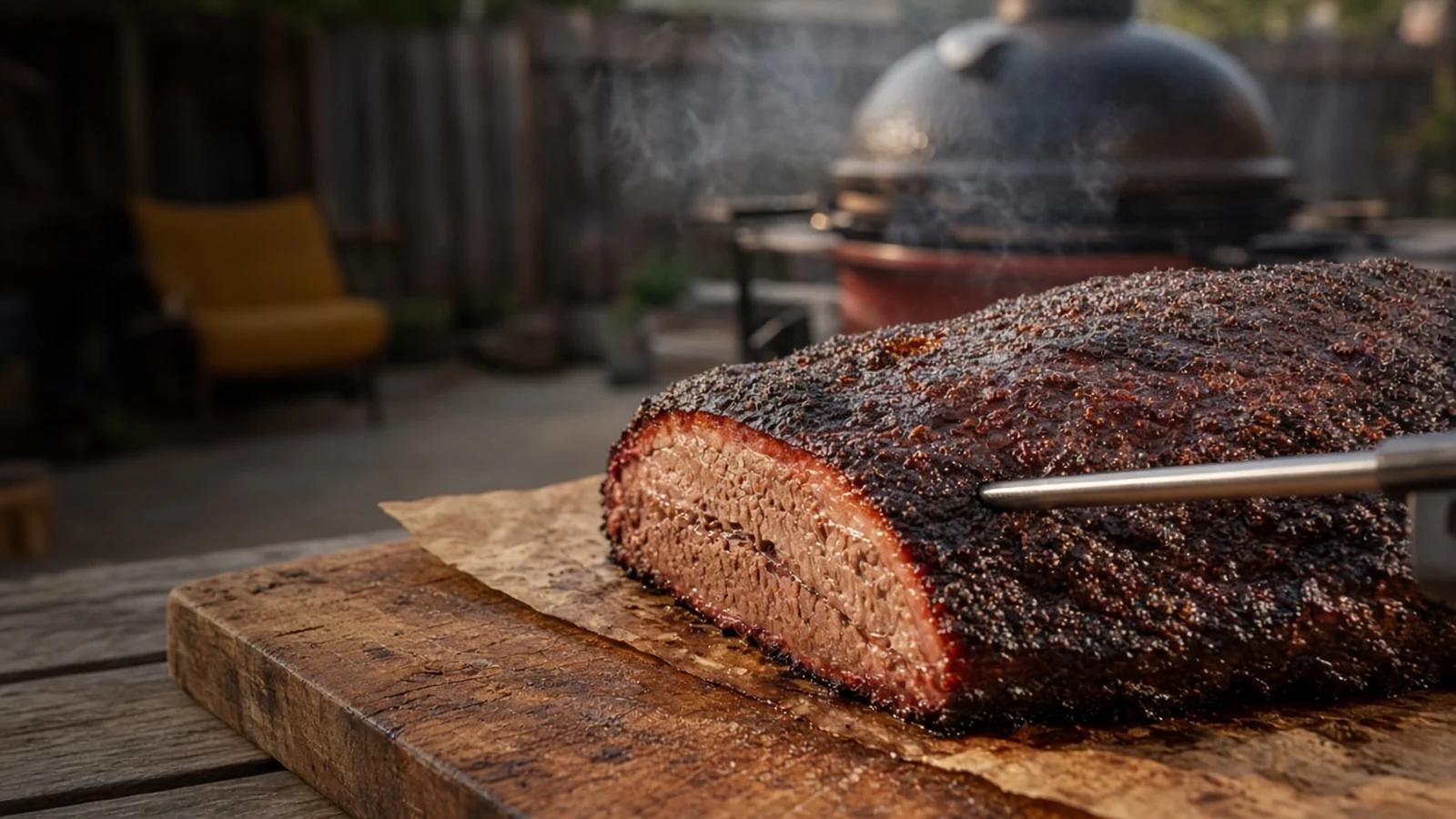
The best thermometer for brisket is a leave-in that stays honest through the stall, plus a grate reading if the pit is what wanders. On this site that is ThermoWorks Signals when you want wires and Wi-Fi, and a wireless probe from the list below when the flat is the job and you know what the handle sensor cannot do.
Quick picks
- ThermoWorks Signals
Four wired channels and Wi-Fi. $259.00 on Amazon, $249.00 on ThermoWorks. The title read Nautical Blue on 9 November 2026.
- FireBoard 2
Six wired channels and Wi-Fi. $199.00 on FireBoard's shop page on 25 October 2026.
- CHEF iQ Sense, one probe
Wi-Fi for one packer you might leave. $99.67 on 9 November 2026.
- ThermoMaven P2
Two probes, a base with a screen, and Wi-Fi. $89.99 on 25 October 2026.
- TempSpike, two probes
Flat and point on Bluetooth, with a booster screen. $99.99 on 28 October 2026.
- Meater Pro
One wireless probe for a brisket you stay with, including a hotter fire. $99.99 on 25 October 2026.
- Meater Plus
One wireless probe for a gentle pit you stay with. $79.99 on 25 October 2026.
Grate and meat
ThermoWorks Signals
For a packer when the grate and the flat both have to stay on the graph, including after you leave the yard.
Pros
- Four wired channels. A grate clip and the flat, and room for the point, ride cables instead of a radio through the lid.
- Wi-Fi means the graph can outlive a trip away. The lid can stay shut through the stall.
Cons
- Four channels. Grate, flat, point, and a second brisket can run out of plugs. FireBoard has six.
- Billows is its own purchase. The Signals box does not hold the vents by itself.
| Channels | Four, wired |
|---|---|
| Link | Wi-Fi and Bluetooth. Title read Nautical Blue on 9 November 2026. |
| Price | $259.00 on Amazon. $249.00 on ThermoWorks. |
Why you'd buy it. A brisket fails in two places: the flat stalls and you wrap on a guess, or the grate sags and you blame the meat. Signals watches both, and the wire does not have to shout through a kamado. Set a grate alarm a little either side of 225 to 275°F and a meat alarm as the flat climbs out of the stall.
Why you wouldn't. You wouldn't buy it for a single wireless hole and no cable across the grate. You also wouldn't buy it expecting the fan in the box. Billows is separate, the same way FireBoard's Drive is separate.
Price and value. Signals was $259.00 on Amazon on 25 October 2026. The listing title read Nautical Blue on 9 November 2026. ThermoWorks' own page listed $249.00 the same day. That money is the logger and the probes in the listing. Four channels cover the grate and the flat, with a plug left for the point.
How it compares. FireBoard's $199.00 buys two more channels and gives up the ThermoWorks probes. A Meater or the one-probe CHEF iQ Sense is the quieter meat probe when you can live without a grate clip. Signals is the wired logger I would run when the pit and the flat are both the cook.
Bottom line. Buy Signals when you want ThermoWorks probes, four channels, and Wi-Fi. The Billows fan is a separate box. There is no score on this site to lean on.
Six channels
FireBoard 2
For the same grate-and-meat job when you want two more plugs and the FireBoard shop price.
Pros
- Six wired channels. Grate, flat, and point, with room left over, on one logger.
- Wi-Fi keeps the graph up with the lid shut, which is the whole point of a long stall.
Cons
- Wires across the grate. That is why it works on ceramic, and it is what you will snag.
- The Drive fan is a separate purchase. The logger alone does not move air.
| Channels | Six, wired |
|---|---|
| Link | Wi-Fi |
| Price | $199.00 on the FireBoard shop page, 25 October 2026 |
Why you'd buy it. You'd buy it on a kamado, where a wireless probe vanishes when the lid closes and the dome gauge reads hotter than the grate. Six channels are enough for the pit, the flat, and the point on the same screen.
Why you wouldn't. You wouldn't buy it if a cable on the grate is the thing you refuse to manage, or if you wanted ThermoWorks probes specifically. You also wouldn't buy it as a fan. Drive is extra.
Price and value. $199.00 on FireBoard's shop page on 25 October 2026 buys the logger. It does not buy the fan. Signals was $259.00 on Amazon and $249.00 on ThermoWorks that day, for four channels. FireBoard is the lower maker price and the higher channel count.
How it compares. Signals is the one to buy when the probes are the reason and four channels is enough. A wireless probe is the one to buy when you are standing there and you want no wire in the flat. On my Joe, FireBoard is the tool I would trust to say the pit is still at 225°F.
Bottom line. Buy it when pit temperature is the failure and six channels is the cook you actually run. The Drive fan is an add-on. The Amazon page I checked for this model returned a 404, so the button stays on FireBoard.
One packer, Wi-Fi
CHEF iQ Sense, one probe
For one brisket you might leave, when the flat is the probe and the grate is watched another way.
Pros
- Wi-Fi, a Smart Hub with a speaker, and phone alerts, at $99.67 on 9 November 2026.
- The listing splits 5 sensors into 4 internal plus 1 ambient, which is useful in a thick flat.
- The bullets say the probe is waterproof and dishwasher-safe, with a 1000°F heat line.
Cons
- One probe. The flat and the point at the same time want a second stick.
- The bullets say up to 50 hours on a charge. The description says up to 70. The within 1°F line is the description, not a logged test.
- The hub does not run a fan, and it does not replace a grate clip on a kamado.
| Probes | One, Gen3, with a Smart Hub |
|---|---|
| Heat | 1000°F endurance, as the listing words it |
| Price | $99.67 on 9 November 2026. List price $129.99. |
Why you'd buy it. You'd buy it so a packer keeps reporting after you leave the yard. Four internal sensors are the listing's answer to a cold spot in the flat. The 4.75 inch length in the description is long enough to reach thick meat if the air-reading end stays in the pit.
Why you wouldn't. You wouldn't buy it as the only grate thermometer. The ambient sensor, whatever end it sits on, is a poor stand-in for a clip at cooking height. You also wouldn't buy it for the flat and the point together. This box is one probe. The four-probe Sense was $204.99 on 11 November 2026, which is a different cook.
Price and value. $99.67 on 9 November 2026, against a $129.99 list price, sold by Amazon.com, is one probe and the hub. The Meater Pro was $99.99 on 25 October 2026 and stays on Bluetooth. You are paying a Meater-shaped bill for Wi-Fi, and you are living with two battery sentences that do not match. The longer page is the CHEF iQ thermometer review.
How it compares. The Plus was $79.99 and stays on Bluetooth for a gentle pit you attend. The Pro was $99.99 with a stated ±0.5°F and a 15-minute charge, also Bluetooth. The P2 was $89.99 for two probes and a screen. This Sense is the Wi-Fi probe for a single flat you might leave.
Bottom line. Buy the one-probe Sense at $99.67 when Wi-Fi on a single Gen3 probe is the job. It is the wrong box when the grate is what drifts.
Flat and point
ThermoMaven P2
For the flat and the point when the base should show both temps and you might leave the yard.
Pros
- Two probes, so the flat and the point can have their own readings.
- The listing says the base sets the target and shows temps without the app, with 2.4 GHz Wi-Fi from the base to the phone.
- Six sensors on the listing, five internal and one external, NIST-certified to ±0.5°F.
Cons
- A dual-band router has to use the 2.4 GHz band. A 5 GHz-only network will not run this base.
- The page carries a Visit the ThermoMaven Store line and a sold-by line for Bryco Goods.
- Ambient on the listing tops out at 752°F, which covers a low smoke and is not the Pro's 1000°F.
| Probes | Two, with a base that has a screen |
|---|---|
| Heat | Internal up to 221°F. Ambient up to 752°F (listing). |
| Price | $89.99 on Amazon. Typical price $99.99. 25 October 2026. |
Why you'd buy it. A packer is two muscles. The flat is the slice people judge, and the point runs ahead. Two probes let you see that split without opening the lid, and the base is something you can read with greasy hands. Wi-Fi is how the listing gets the cook off Bluetooth after the base has the reading.
Why you wouldn't. You wouldn't buy it as a grate logger. A kamado still sits between the probes and the base. You also wouldn't ignore the seller line. Read who is selling it at checkout.
Price and value. $89.99 on 25 October 2026, with a typical-price line of $99.99, is two probes, a screen, and Wi-Fi, under the price of one Meater Pro that day. The listing says internal up to 221°F, ambient up to 752°F, and IPX8 probes that can go in the dishwasher. I have not logged the ±0.5°F line.
How it compares. The TempSpike pair was $99.99 on 28 October 2026 and shows temps on a booster, without Wi-Fi. The one-probe CHEF iQ was $99.67 for a single stick and a hub. Signals still has the easier time telling you the grate, because the signal walks a wire. The P2 is the wireless pair for a brisket you might leave.
Bottom line. Buy the P2 when two probes, a screen, and Wi-Fi are the brisket you run. Read the seller line before you check out. It was $89.99 on 25 October 2026.
Two probes, in the yard
TempSpike, two probes
For the flat and the point while you stay near the booster, and you want the temps on a small screen.
Pros
- Two color-coded probes, so the flat and the point are separate readings.
- The listing says the LCD booster shows meat and ambient without the app, on Bluetooth 5.2 up to 600 feet.
- $99.99 on 28 October 2026, the same day-price band as a single Meater Pro, for two probes.
Cons
- No Wi-Fi. Leaving the house is a different tool, and a closed lid still shortens the hop.
- The listing does not state an internal sensor ceiling. The 1050°F line is what the ceramic can withstand.
| Probes | Two color-coded probes and an LCD booster |
|---|---|
| Link | Bluetooth 5.2, up to 600 ft. No Wi-Fi. |
| Price | $99.99 on Amazon, 28 October 2026 |
Why you'd buy it. You'd buy it to watch the flat and the point without a phone in your hand, while you stay in the yard. The booster screen is the part that matters at hour ten, when you want the number and your hands are a mess.
Why you wouldn't. You wouldn't buy it to leave. There is no Wi-Fi in this listing. You also wouldn't treat 1050°F as an ambient sensor maximum. The page says the ceramic can withstand that heat, and it does not print a sensor ceiling next to it.
Price and value. $99.99 on 28 October 2026 is two probes and a booster. The one-probe CHEF iQ was $99.67 for Wi-Fi and one stick. The P2 was $89.99 for two probes, a screen, and Wi-Fi, with a seller line to read. The TempSpike pair is the Bluetooth pair with the booster.
How it compares. Meater's single probes cost the same kind of money for one hole. Signals costs more and adds the grate on a wire. The pair is the pick when two places in one packer matter and you will be close enough for Bluetooth.
Bottom line. Buy the pair when Bluetooth is enough and a second probe matters. It was $99.99 on 28 October 2026. It does not join Wi-Fi.
One probe, in the yard
Meater Pro
For one brisket while you stay close enough for Bluetooth, including a fire hotter than a low pit.
Pros
- Five internal sensors, so a cold spot in the flat is harder to miss than with a single tip.
- Ambient maximum 1000°F, and internal maximum 221°F at about ±0.5°F, on Meater's Pro page.
- A 15-minute charge is rated for about 12 hours. The probe is waterproof and dishwasher-safe.
Cons
- No Wi-Fi on the single Pro. The home-range figure, about 250 feet, is charger to phone.
- One probe. The point is a guess unless you check it another way.
- The charger is not waterproof or fireproof. A kamado still sits between the probe and that charger.
| Internal max | 221°F, about ±0.5°F (maker) |
|---|---|
| Ambient max | 1000°F (maker) |
| Price | $99.99 on Amazon and on meater.com, 25 October 2026 |
Why you'd buy it. You'd buy it for one packer, five sensors in the meat, and a handle rated for a hotter fire than a 250°F pit. Keep the charger just outside the hinge. Pull around 203°F and probe-tender, and let the app's countdown sit in the background. The full page is the Meater Pro review.
Why you wouldn't. You wouldn't buy it to leave the house, to log the grate through a ceramic lid, or to watch the point at the same time. A 12-hour charge rating is also the tighter Meater sentence on a very long unwrapped cook, so start it full.
Price and value. $99.99 on Meater's Pro page and on Amazon, both read on 25 October 2026, buys one probe and the Bluetooth charger. You get the ceilings and the fast-charge claim. You get one piece of meat. A fan is a different tool.
How it compares. The Plus was $79.99 that day and stops at 527°F ambient, which is enough for a gentle brisket and the wrong handle for a sear. The one-probe CHEF iQ was $99.67 and adds Wi-Fi. FireBoard still has the easier grate reading on my Joe. The Pro is the meat probe beside that wire when I am staying home.
Bottom line. This is the wireless probe I would put in the flat on a day I am in the yard. If the cook has to keep reporting after you leave, you want Wi-Fi in a different box.
Gentle pit
Meater Plus
For one brisket at 225 to 275°F, with the phone near the charger and no high heat on the ceramic end.
Pros
- $79.99 on 25 October 2026 bought one probe, a bamboo charger, and an AAA battery.
- A 212°F internal ceiling still clears a brisket pulled around 203°F.
- The support guide rates about 24 hours of cooking after a full charge, which covers a packer if you charged it.
Cons
- Ambient maximum 527°F. Meater does not recommend this probe over an open flame.
- No Wi-Fi. About 165 feet is charger to phone, and about 33 feet is probe to dock in open air.
- The first charge is about 4 hours. You are not buying a 15-minute top-up.
| Internal max | 212°F (maker) |
|---|---|
| Ambient max | 527°F (maker) |
| Price | $79.99 on Amazon and on meater.com, 25 October 2026 |
Why you'd buy it. A 250°F brisket never asks for a 1000°F handle. The Plus costs less than the probe that has one, and 203°F sits under the 212°F internal ceiling. Charge it the night before. The Meater Plus review has the hops written out.
Why you wouldn't. You wouldn't buy it for a sear, for Wi-Fi, or for the point and the flat together. Meater's ambient note says that sensor helps the app estimate time and is not there to confirm the pit's set point. The grate on my Joe is still a wire.
Price and value. $79.99 on the Plus page and on Amazon, read on 25 October 2026, is twenty dollars under the Pro that day. The Meater Block was $239.95 on 29 October 2026 for four of these probes and Wi-Fi, at the same 212°F and 527°F ceilings. The Plus is the single for a gentle brisket you attend.
How it compares. The Pro is the step up when the handle might see high heat. The one-probe CHEF iQ at $99.67 is the step up when you might leave. The Plus is the probe I would use for a packer I am cooking in the yard at 225 to 275°F.
Bottom line. Buy the Plus when the smoke stays gentle and $79.99 is the number that fits. Buy the Pro if the fire might spike. Buy a Wi-Fi probe if the plan is to leave.
Comparison
Prices are the figures already printed on this site, on the dates in each block. Nothing in the table is a score from a cook here.
| Thermometer | What it watches on a brisket | Leave the yard? | Price already on this site |
|---|---|---|---|
| ThermoWorks Signals | Grate plus flat, on wires. Room for the point. | Yes, on Wi-Fi | $259.00 on Amazon. $249.00 on ThermoWorks. Nautical Blue on the later title. |
| FireBoard 2 | Grate, flat, and point, with plugs left over | Yes, on Wi-Fi | $199.00 on FireBoard, 25 October 2026 |
| CHEF iQ Sense, 1 probe | One flat, four internal sensors plus ambient | Yes, once the hub has the reading | $99.67 on 9 November 2026. List $129.99. |
| ThermoMaven P2 | Flat and point, screen on the base | Yes, on 2.4 GHz Wi-Fi from the base | $89.99 on 25 October 2026. Typical price $99.99. |
| TempSpike, two probes | Flat and point, screen on the booster | No. Bluetooth only. | $99.99 on 28 October 2026 |
| Meater Pro | One flat, five internal sensors | No, on the single Pro | $99.99 on 25 October 2026 |
| Meater Plus | One flat at 225 to 275°F | No | $79.99 on 25 October 2026 |
How the list was chosen
A brisket thermometer has to last a long cook, tell you the stall is the meat and not a dead fire, and still be in the flat when you check for probe-tender. I kept the tools already written up that do one of those jobs cleanly. Signals and FireBoard are the grate-and-meat loggers. The one-probe CHEF iQ Sense is the Wi-Fi stick for a single flat. The P2 and the TempSpike pair are the two-probe boxes, one with Wi-Fi and one without. The Pro and the Plus are the single wireless probes for a cook you attend.
I left the wider wireless catalog on best wireless meat thermometer. Combustion's Wi-Fi Display kit was $229 on 26 October 2026 for eight sensors and a screen, and I would still want a grate wire beside it. The four-probe CHEF iQ Sense was $204.99 on 11 November 2026, which is several cuts, not one packer. The Meater Pro Duo was $179.99 for two probes and Wi-Fi. The single TP970 was $39.99. Those are real boxes. They are a different shape of cook than the seven above.
There is no scored cook-off on this page. I have not published a probe-versus-reference error, a battery runtime, or a hold test. Maker lines stay attached to the page that printed them. A pocket instant-read, the kind you stab in three spots at the end, is not covered on this page. The leave-in already in the flat is how these plans start the slide test.
What a brisket cook needs
The cook is long. A 12 to 15 pound packer at 225°F runs about 12 to 20 hours depending on the wrap, which is how long to smoke a brisket. The probe has to be charged for that, and the grate has to still be the temperature you planned. A wireless handle that dies at hour six looks exactly like a stall until you notice the pit has sagged with it.
You want the meat and, when you can, the pit. The flat is the slice. The grate is the fire. The dome on a kamado sits above the meat and usually reads hotter. Plans on this site mean grate temperature. A leave-in in the flat does not settle the bottom vent.
The stall is a flat line around 150 to 170°F while the surface dries. The thermometer is telling the truth. The meat is not done. Wrapping because the graph looked broken, with the grate actually falling, steams a pale brisket over a weak fire. Read both numbers. The pause itself is the brisket stall.
Probe-tender is the finish, not a single beep. Around 203°F in the thick flat, a probe slides with little pressure, like warm butter. The point often feels that way first. The page for the number and the feel is brisket internal temp.
Alarms are how you sleep or leave the yard. One as the flat enters the stall, so you know the pause started. One through the upper 190s, so you start checking. A grate alarm on a wired logger, a little either side of the setpoint, so a dying fire wakes you before the bark tells the story. The app's finish time can sit on the phone. It is not the decision. On a Meater, a countdown that keeps jumping is Meater time estimate wrong.
Where to place the probe
Season with the brisket rub before the probe goes in. The bark sets early, and you do not want to be salting around a hole you were glad did not have a wire.
- Put the tip in the thickest part of the flat, in the lean meat. Stay off the fat cap and off the fat seam between the flat and the point. Fat reads hot.
- Keep the tip off the plate setter, the steel deck, and the thin edge of the flat. Those spots read the heat around the meat.
- On a wireless probe, leave the ambient end in the pit air. Bury that end and the air reading becomes another meat reading, and the radio has a worse path out of the meat. Meater's sensors sit toward the tip, with the ceramic at the handle. The CHEF iQ listing does not draw that layout, so leave whichever end reads the air in the air.
- If you have a second meat probe, put it in the thick point, still off the fat seam. The point runs ahead. That gap is the cook, not a broken probe.
- If you have a wired logger, clip one probe at grate level beside the meat, in the air the flat is sitting in. The lid gauge is the wrong witness.
- Leave the probe in through the wrap. Pulling it to wrap, then stabbing a new hole, loses the graph and drags rub inside. Foil hurts a wireless hop. Pink butcher paper is the kinder wrap, on butcher paper vs foil.
- When the flat climbs through the upper 190s, start the slide test in that same thick meat. Around 203°F and a probe that slides with little pressure, rest it. The temperature says it is time to check. The feel says it is time to rest.
The short version of the thermometer choice, before this brisket cut of the list, is meat thermometers for smoking. The cook around the probe is how to smoke a brisket. The hours are on the brisket calculator.