
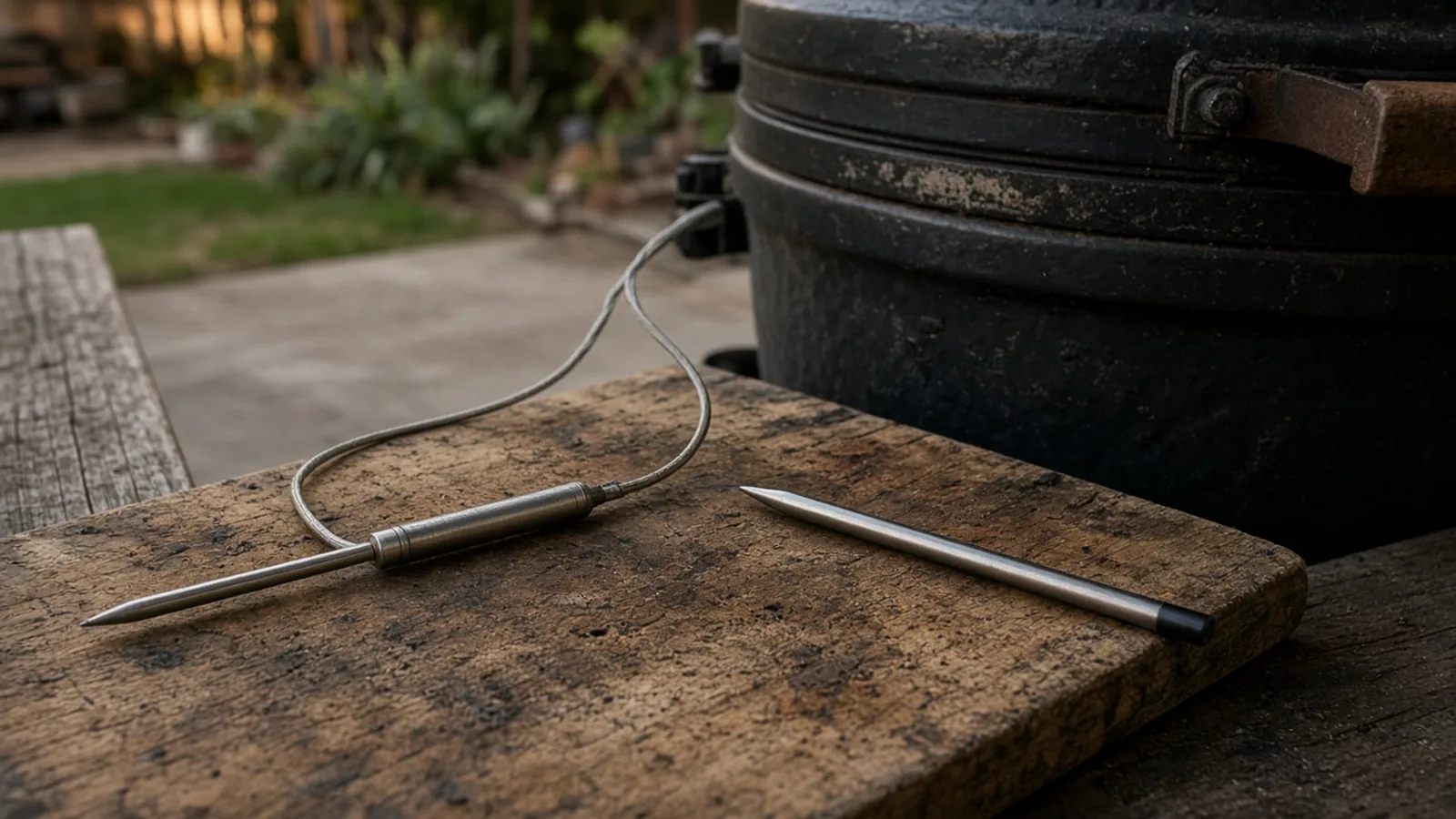
A wired meat thermometer keeps its signal on a cable, so the grate reading survives a shut lid. A wireless meat thermometer puts the radio in the probe, which is the right tool in the meat when you stay near the cooker and a cable would snag.
How a wired probe works
The sensor sits in a metal probe in the meat, or clipped in the air at the grate. A cable carries that reading to a base that lives outside the cooker, on the side table, where the lid cannot sit on the radio. Bluetooth or Wi-Fi, if the logger has them, starts at that base in open air. The cable is the part that crosses the gasket. You close the lid on a wire, and the graph keeps updating because nothing had to shout through ceramic or steel.
A second channel is the reason a wired logger earns its place on a long smoke. One probe in the thick of the meat, one at the grate. The plans on this site mean grate temperature when they say 225°F. The thermometer in a kamado lid sits up in the dome and usually reads hotter than the air around the meat. A wire at the grate is how you see that gap with the lid shut. The lists that sort those loggers are best meat thermometer for smoking and, beside the wireless probes, best wireless meat thermometer.
Pros
- The signal walks a cable, so a shut lid does not have to pass a radio.
- A second channel can watch the grate and the meat on the same screen for the whole cook.
Cons
- The cable crosses the grate, and it is the thing you snag when you move a rack.
- A pinched cable at the lid is the part that fails, and a probe left in flame cooks the insulation.
How a wireless probe works
The battery, the sensors, and the radio live in the probe. You push the tip into the meat and leave the other end in the pit air, if that end is the one that reads ambient. There is no cable across the grate, which is the whole appeal on a rotisserie, a crowded rack, or any cook you turn. The phone, or a charger that boosts the signal, has to hear that probe through whatever is wrapped around it: a steel lid, a ceramic dome, or a sheet of foil.
Meater's Pro page describes five internal sensors, an internal maximum of 221°F at about ±0.5°F, and an ambient sensor up to 1000°F. The single Pro is Bluetooth. It has no Wi-Fi in that charger. Meater's Plus page is the older shape: one internal reading and one at the handle, an internal maximum of 212°F, an ambient maximum of 527°F, and Bluetooth they print at up to about 165 feet, with the cooker changing that hop. The Meater Pro review and the Meater Plus review are the long versions, including what a closed lid and a foil wrap did in a published range walk of the Pro hardware.
The CHEF iQ thermometer review is the reviewed probe that puts Wi-Fi in the box. The listing calls it one ultra-thin probe, a Smart Hub, Wi-Fi, a 1000°F heat line, and five sensors split into four internal plus one ambient. The description says the probe is accurate within 1°F. That is the listing's sentence. This site has not checked it against a reference thermometer. The hub stays outside the cooker. The short hop is still probe to hub, through the lid. The long hop, hub to phone over Wi-Fi, is what "check it from anywhere" is doing once the hub has the reading.
Pros
- One hole in the meat, and no cable to trap in the lid or wind around a spit.
- An ambient sensor on the same probe can sketch the pit air, as long as that end stays out of the meat.
Cons
- The lid, the steel, and a foil wrap sit between the probe and the phone. Open-air range is the number on the box.
- The handle has a heat ceiling. A Plus is rated to 527°F ambient, and a sealed probe is not a cable you replace for a few dollars.
Nothing on this page is a scored ranking from my pit. When a number is a maker's, the sentence says so. A score still waits on a logged cook and a reference probe.
On a kamado
I cook on a Kamado Joe, and the failure I keep planning for is a probe that vanishes when ceramic sits between the sensor and the phone. The range on the box is open air. The lid is the test. A wired probe at the grate is the number I trust for 225°F, because the dome gauge is already reading the hotter air up in the lid.
A wireless probe can still live in a brisket flat or a pork butt if the charger sits just outside the hinge and I am in the yard to glance at the phone. The day the graph dies at the stall, the stall may be real and the radio may be the lid. Those are different problems. The grate reading moves to a wire. The meat reading can stay wireless if it is still talking. Both jobs, side by side, are the split on best meat thermometer for smoking.
On an offset
An offset runs hotter at the firebox end than at the far plate. The thermometer in the door is often reading a different pocket of air from the grate where the meat sits. A wired probe clipped at the meat tells you the air that cook is actually in, and you can move the rack when that end runs away.
The cook is long, and the pit is a steel box. Bluetooth from inside that box has the same kind of trouble it has in a kamado: the wall is in the way. A wireless probe in the brisket is still a fair meat reading if the charger is close and you stay nearby. If you leave, you want Wi-Fi that does not depend on a radio crossing the steel. On a reviewed wireless probe, that is the CHEF iQ Sense and its hub. On a wire, it is a logger that can use Wi-Fi, which is the job best meat thermometer for smoking is sorting.
On a pellet grill
A pellet grill already has a controller trying to hold the set temperature. For one piece of meat, while you stay in the yard, a wireless probe in the thick of the cut is the reading that matters, and the controller is the pit number until it gives you a reason to doubt it. A Meater Plus matches a 225 to 275°F cook. A Meater Pro is the same job with a higher ambient ceiling if the grill spikes.
Add a wired grate probe when you want a second opinion on that controller, or when the cook is long enough that you will leave the house and you want the graph on Wi-Fi without hoping the lid passes a Bluetooth hop. The steel lid still shortens a wireless probe's open-air claim. The hopper side of the lid is not a radio window.
In the oven
An oven door will close on a thin probe cable, and the base sits on the counter in open air. That is a simple wired cook: one probe in a roast, an alarm when it hits the number, no app required if the base has a screen. A wireless probe does the same job with a cleaner door seal, and then the steel box is the obstacle. The phone or the charger wants to be close, or the hub wants to be on Wi-Fi the way the CHEF iQ review describes.
Heat is the other oven question. A gentle roast sits inside both Meater ceilings. A broiler, or a pan you want to sear with the probe still in, is the cook that wants the Pro's 1000°F ambient rating. Meater's Plus page says they do not recommend those Alpha probes over an open flame, and the ambient ceiling there is 527°F. Take the Plus out before that heat.
On a rotisserie
The spit turns. A cable turns with it unless you have arranged a slack loop that never winds up, which is a bad bet once the cook is going and you are not standing on the cable. A wireless probe turns inside the meat and stays put. That is the cooker where wireless is the practical leave-in, and a wired probe is the one you use for a quick grate check that you can unclip.
A rotisserie also runs hot near the burner or the coals. The handle of a wireless probe sees that air. The Plus, at 527°F ambient, is the low-and-slow tool. The Pro, at 1000°F ambient on Meater's page, is the reviewed wireless probe for a hotter fire. The CHEF iQ listing's 1000°F line is a heat-endurance sentence, written up in the CHEF iQ review, and this site has not put that probe on a spit.
By cook length
A cook under about two hours, chicken pieces or a weeknight roast, can use either leave-in if you are in the room. You can also poke it at the end with an instant-read. This page does not sell that pocket thermometer. The leave-in is for the hours you do not want to open the lid.
A rib afternoon, roughly three to six hours, is a pleasant wireless cook if you stay outside. The meat is thin, and a probe in a rib bone lies, so the wireless probe is more useful in a thicker roast on the same pit than it is buried in a rack. The grate, if you are chasing 225°F for 3-2-1 ribs or an unwrapped rack, is still a wire. Ribs end on the bend test either way.
A packer or a pork butt is the long one, often ten hours and up. You will leave the pit. Bluetooth that needs you within a short walk is the wrong radio for that day. Wi-Fi on the CHEF iQ Sense is the reviewed wireless way to leave. A wired logger with Wi-Fi is the other way, and it is the one that can also hold the grate number while you are gone. The stall on a brisket looks like a dead fire if you only glance once an hour. An alarm on a real grate reading is what keeps you from wrapping a cook that was only cold.
Range and connectivity
America's Test Kitchen split the radios by how far they actually carried a temperature. Bluetooth-only models, in their tests, often wanted the phone within about 10 to 20 feet. A base that boosts the signal stretched some of them, and still not as far as the Wi-Fi units. Those Wi-Fi thermometers could be read from miles away, and they were only as good as the internet they were on. A backyard with no Wi-Fi does not get the mile. Simple radio models they tested landed in between, about 30 to 40 feet in their experience.
That shape matches the maker pages, read as ceilings. Meater's Plus page prints up to about 165 feet and tells you the cooker, the obstacles, and the phone change it. The Pro review records a published walk of this hardware: a long line of sight in open air, a much shorter connection through a closed ceramic cooker, and a worse one in foil. I have not repeated that walk on my Joe. What I take from it is the order. Open air is the long number. A closed lid is the short one. Foil is worse. The wireless roundup is where those designs sit next to each other.
Wi-Fi does not skip the lid. It moves the long hop to a hub that already has the reading. The probe still has to reach that hub. Put the hub outside the cooker, close to the lid, on the same side as the hinge if the probe is a Meater and the charger is the booster. Then the phone can go in the house.
Accuracy and durability
America's Test Kitchen preferred the remote probes that stayed within about a degree of a known temperature. Meater prints about ±0.5°F on the Pro's internal sensors. The CHEF iQ listing says within 1°F, and that sentence is untested here. At a 225 to 275°F smoke, a degree or two in the meat is a smaller deal than a grate reading that is off by twenty because you trusted the dome. I have not published a probe-versus-reference error for any of them.
The ambient reading on a wireless probe is a different claim from the internal one. The Barbecue Lab ran several wireless probes in one pork butt and compared their ambient sensors with wired grate probes. Early in that cook, some wireless ambient numbers were far from the wired grate reading, by tens of degrees, and they took hours to settle closer. I have not repeated their chart. The practical reading is the one their cook points at: a handle sensor is a sketch of the air around that handle, and a wired probe clipped where the meat sits is the grate number to cook from. Bury the wireless handle and you lose even the sketch.
Durability follows the part that takes the abuse. On a wire, that part is the cable, kinked at the lid and scorched if it droops into flame. The base stays on the table. On a wireless probe, the handle takes the pit air, and the battery is sealed inside a stick you cannot splice. The Plus charger takes a replaceable battery. The probe itself does not. A 527°F ambient ceiling is a real limit on the Plus page, and crossing it is how that stick gets cooked. The Pro's 1000°F ambient line is why it is the one of the two Meaters for a hotter fire. Neither one runs a fan. A wandering vent is a wired logger's job, and the fan, on the loggers in the smoking roundup, is a separate box.
Wired and wireless, side by side
| Wired leave-in | Wireless probe | |
|---|---|---|
| How the signal leaves the pit | A cable to a base outside the lid | A radio in the probe |
| Grate temperature | A second probe clipped at the meat | The handle sensor, if that end stays in the air |
| Lid shut for hours | The graph keeps updating | The lid is the obstacle |
| Leaving the house | Wi-Fi on the base, when the logger has it | Wi-Fi only after a hub has the reading, as on the CHEF iQ Sense |
| Heat at the probe | Keep the cable out of the flame | Plus ambient max 527°F. Pro ambient max 1000°F. CHEF iQ lists 1000°F endurance |
| What you fight | A cable across the grate | The app, the charger distance, and foil |
| Reviewed picks on this site | The wired loggers in the two roundups | Meater Pro, Meater Plus, CHEF iQ Sense |
Buy the wire when the grate has to stay honest and you may leave. Buy the wireless probe when one piece of meat is the job and you will be in the yard. The Meater Pro is that probe when the fire might run hot. The Meater Plus is that probe when the cook stays low. The CHEF iQ Sense is the reviewed wireless probe with Wi-Fi in the box. The longer lists, prices included, stay on best meat thermometer for smoking and best wireless meat thermometer.